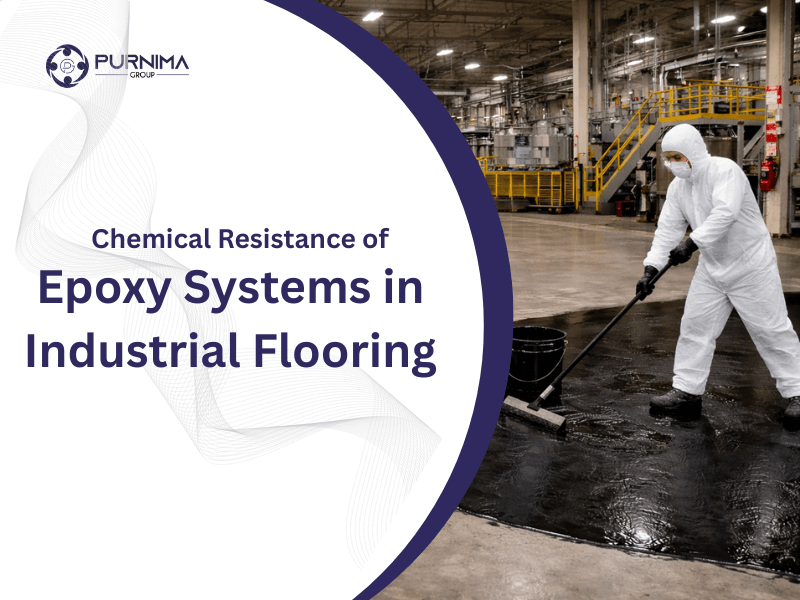
Industrial environments place extreme demands on flooring systems. Beyond mechanical loads, abrasion, and thermal cycling, one of the most critical performance requirements is resistance to chemical exposure. From manufacturing plants and warehouses to laboratories and processing facilities, floors are routinely exposed to acids, alkalis, solvents, oils, fuels, and cleaning agents. In this context, epoxy-based flooring systems have become the preferred choice across industries due to their proven chemical resistance, durability, and long-term performance.
At Purnima Groups, ind ustrial flooring solutions are designed with a clear understanding that chemical resistance is not a single property but the result of material science, formulation quality, surface preparation, and application expertise working together.
Understanding Chemical Resistance in Industrial Flooring
Chemical resistance refers to a flooring system’s ability to withstand exposure to aggressive substances without suffering degradation in appearance, strength, adhesion, or functionality. In industrial flooring, this resistance is measured not only by whether a surface stains or discolors, but also by whether it maintains structural integrity over repeated and prolonged chemical contact.
Epoxy systems are thermosetting polymers formed through a chemical reaction between epoxy resins and curing agents. Once cured, they form a dense, cross-linked network that significantly limits chemical penetration. This molecular structure is the foundation of epoxy’s resistance to corrosive substances. However, not all epoxy systems offer the same level of protection. Performance varies depending on resin chemistry, hardener selection, film thickness, and environmental exposure conditions.
Why Epoxy Systems Excel in Chemically Aggressive Environments
Epoxy flooring systems are widely used in industrial settings because they provide a balanced combination of chemical resistance, mechanical strength, and surface impermeability. The tightly cross-linked polymer matrix reduces porosity, which limits absorption of liquids and vapors that could otherwise attack the substrate.
Another critical advantage is epoxy’s ability to bond strongly to concrete substrates. This adhesion prevents chemical ingress beneath the flooring, where hidden degradation could compromise both the floor and the underlying structure. When properly applied, epoxy systems act as a continuous protective barrier rather than a superficial coating.
Chemical Classes and Their Impact on Flooring Performance
To evaluate chemical resistance effectively, it is important to understand the different classes of chemicals commonly encountered in industrial facilities and how they interact with epoxy systems.
Resistance to Acids
Epoxy flooring generally demonstrates strong resistance to many inorganic and organic acids, particularly when exposure is intermittent or of moderate concentration. Diluted sulfuric acid, hydrochloric acid, and phosphoric acid are commonly encountered in manufacturing and processing plants. High-performance epoxy systems are formulated to withstand these exposures without softening or blistering.
However, prolonged exposure to highly concentrated acids can eventually affect standard epoxy coatings. In such cases, specialized formulations or additional protective topcoats are often recommended. The selection of the correct epoxy chemistry is therefore essential for acid-intensive environments.
Resistance to Alkalis and Bases
Alkaline substances, including caustic soda, ammonia solutions, and alkaline cleaners, are frequently used in food processing, pharmaceutical, and sanitation-driven industries. Epoxy systems typically perform exceptionally well under alkaline exposure due to their inherent chemical stability in high-pH conditions.
This resistance makes epoxy flooring particularly suitable for wash-down areas, production zones, and facilities where aggressive cleaning protocols are mandatory. Long-term resistance depends on proper curing and film thickness, as insufficient cross-linking can reduce durability.
Resistance to Solvents and Hydrocarbons
Solvents and hydrocarbons present a more complex challenge for flooring systems. Substances such as gasoline, diesel, kerosene, and aromatic solvents can cause swelling or softening in lower-grade coatings. High-quality epoxy systems, especially those designed for industrial and automotive environments, offer strong resistance to fuels, lubricants, and oils.
Solvent resistance depends heavily on resin purity and cross-link density. Systems developed for industrial flooring by Purnima Groups are engineered to minimize solvent absorption and maintain hardness even under frequent exposure.
Resistance to Salts, Brines, and Industrial Chemicals
Salts, brines, and chemical solutions used in processing and storage environments can be highly corrosive to concrete substrates. Epoxy flooring acts as a protective membrane, preventing salt crystallization and chemical penetration that can lead to concrete spalling and reinforcement corrosion.
This is particularly important in cold storage facilities, chemical warehouses, and marine-adjacent industrial zones where chloride exposure is common.
Factors That Influence Chemical Resistance of Epoxy Flooring
While epoxy systems are inherently resistant to many chemicals, their real-world performance is influenced by several critical factors that must be addressed during design and installation.
Resin and Hardener Chemistry
The chemical composition of the epoxy resin and curing agent plays a defining role in resistance levels. Bisphenol-based epoxies, novolac epoxies, and modified formulations each offer different resistance profiles. Novolac epoxy systems, for example, provide superior resistance to aggressive acids and solvents due to their higher cross-link density.
Choosing the correct formulation is a technical decision that should be aligned with the specific chemical exposure expected in the facility.
Film Thickness and System Build
Chemical resistance increases with coating thickness. Thin films may offer surface protection but can be breached over time by aggressive chemicals. Industrial epoxy flooring systems are typically applied in multiple layers, creating a robust barrier that enhances resistance and extends service life.
High-build and self-leveling epoxy systems are often preferred in environments with frequent chemical spills or immersion.
Surface Preparation and Adhesion
Even the most chemically resistant epoxy system will fail if surface preparation is inadequate. Proper mechanical preparation of the concrete substrate ensures optimal adhesion and eliminates pathways for chemical migration.
At Purnima Groups, strict surface preparation protocols are followed to ensure the epoxy system performs as intended under chemical stress.
Curing Conditions and Application Quality
Chemical resistance develops fully only after complete curing. Temperature, humidity, and application technique directly influence curing behavior. Incomplete curing can result in reduced cross-linking, making the floor more vulnerable to chemical attack.
Professional application and controlled curing conditions are therefore essential for achieving long-term resistance.
Industrial Applications Where Chemical Resistance Is Critical
Epoxy flooring systems are deployed across a wide range of industries where chemical exposure is unavoidable.
Manufacturing and Processing Plants
Manufacturing facilities often involve exposure to lubricants, coolants, cleaning agents, and process chemicals. Epoxy flooring provides a durable, easy-to-clean surface that resists chemical degradation while supporting operational efficiency.
Pharmaceutical and Laboratory Facilities
In pharmaceutical and laboratory environments, chemical spills and stringent hygiene requirements are common. Epoxy flooring systems offer resistance to reagents, disinfectants, and solvents while maintaining seamless, non-porous surfaces that support contamination control.
Food and Beverage Industries
Although food-grade environments require compliance with safety and hygiene standards, chemical resistance remains crucial due to frequent wash-downs and cleaning chemicals. Epoxy systems used in these settings are designed to withstand alkaline and acidic cleaners without surface breakdown.
Warehouses and Chemical Storage Areas
Chemical storage zones demand flooring systems that can withstand accidental spills and prolonged exposure. Epoxy flooring acts as a containment layer, reducing environmental risk and protecting structural assets.
Maintenance and Longevity Under Chemical Exposure
Chemical resistance does not eliminate the need for proper maintenance. Prompt cleanup of spills, routine inspections, and adherence to recommended cleaning practices significantly extend the lifespan of epoxy flooring systems.
Over time, even highly resistant systems may benefit from recoating or surface renewal, particularly in zones of constant chemical exposure. Planned maintenance ensures continued protection without the need for full system replacement.
Selecting the Right Epoxy Flooring Partner
Chemical resistance is not achieved through materials alone. It requires technical expertise, accurate assessment of exposure conditions, and disciplined execution. Selecting a flooring partner with proven experience in industrial environments is critical.
Purnima Groups approaches epoxy flooring projects with a performance-first mindset, ensuring that each system is specified and installed to meet the chemical, mechanical, and operational demands of the facility.
Long-Term Performance and Operational Confidence
Industrial flooring is a long-term investment, and chemical resistance plays a decisive role in its return on investment. Epoxy systems, when properly designed and applied, deliver years of reliable service even in harsh chemical environments. They protect infrastructure, improve safety, and reduce maintenance costs while maintaining a professional industrial appearance.
For industries where chemical exposure is part of daily operations, epoxy flooring systems represent a practical, resilient, and scientifically proven solution. With the right formulation, installation, and maintenance strategy, they provide consistent performance that supports both operational efficiency and asset protection well into the future.